Hello dear readers, in this article we will discuss the use of Gann's theory in the financial markets. The strategies that have been successfully employed in the financial markets where Gann has operated for many years stand out as a rich synthesis of geometric, astrological, and mathematical knowledge. These strategies are effectively employed across a wide range, from currency exchange rates to commodities, from oil to stocks, from precious metals to cryptocurrencies. As Gann's developed theory began to guide traders all around the world, with its scientific approach, understanding and evaluating market movements became more precise and reliable. The mathematical and geometric principles developed by William Delbert Gann are utilized in predicting price movements in financial markets.
Why Modern Traders Still Rely on Gann Principles
Markets have changed drastically since the early 20th century, yet the core psychology behind price movements remains remarkably consistent. Modern traders continue to rely on Gann principles because these methods look beyond simple price action, treating the market as a predictable mathematical map where time and geometry intersect. While high-frequency trading and complex algorithms now dominate the screens, the foundational idea that history repeats itself in specific cycles allows Gann's century-old techniques to provide a sense of order in today's volatile environment. Traders gain a unique edge in anticipating where a trend might exhaust itself or where a new one is likely to begin as they integrate these timeless ratios into various timeframes.
There are some key principles that stand out in Gann analysis:
- Geometric Patterns: Geometric patterns are used to understand the relationship between price movements and time in Gann's theory. These patterns can help identify important turning points for the time periods indicated on line charts and can contribute to trend following.
- Price and Time Relationship: The relationship between price movements and time plays a central role in this fundamental principle. This approach anticipates that prices change over time and within a specific time period, prices can form recurring patterns.
- Support and Resistance Levels: Support and resistance levels are considered important levels at which the price can turn up or down at a given point in this principle. These levels can be identified between price movements using certain ratios.
- Trends and Turning Points: Trends play a critical role in determining the direction of price movements in Gann analysis. Trend lines are drawn at a specific angle and used to ascertain whether the price is moving above or below a certain level. Turning points occur when the price departs from its current direction and begins to move in the opposite direction. These points are recognized as where trends reverse and new trends commence.
Gann used weekly, monthly time frames in his analysis when trading commodities. Therefore, we can say it is more compatible with a long-term trading style. However, in the current situation, traders are using Gann analysis across almost all timeframes.
Gann Fan
Gann focused on time-related research derived from the trio of time, price, and pattern. Particularly, using angles and geometric structures, he divided price and time into proportional segments, emphasizing the profound capability of this approach in predicting price movements. Time is further divided into smaller and more manageable intervals each year in this context. Mathematical connections exist among these time intervals, and specific troughs and peaks are also identified. Gann elucidated this matter by emphasizing three distinct timeframes when explaining:
- Based on the dates of major peak and trough points, he suggests that these time levels could play a critical role in periods one year ahead.
- After the formations of major peaks and troughs, it indicates the possibility of a new reversal in a short period, such as one month.
- Reaction movements in prices or trend characteristics often occur within 10-14 days, but when these periods are exceeded, it suggests waiting for a longer period, around 28-30 days.
A Gann Fan is shaped by Gann angles, which comprise a series of nine different diagonal lines. These lines are referred to as Gann angles and are drawn on a price chart to identify various support and resistance levels for financial instruments. Gann angles are formed through the proportional division of time and price. Of particular note is the 1x1 or 45-degree angle. According to Gann, this angle represents one price unit for one time unit. Its fundamental concept is to express a 45-degree angle of one unit price increase each day. Additionally, other significant angles like 2x1 (two units upward movement per day), 3x1, 4x1, 8x1, and 16x1 are also present. All these distinct Gann angles come together to form the Gann Fan.
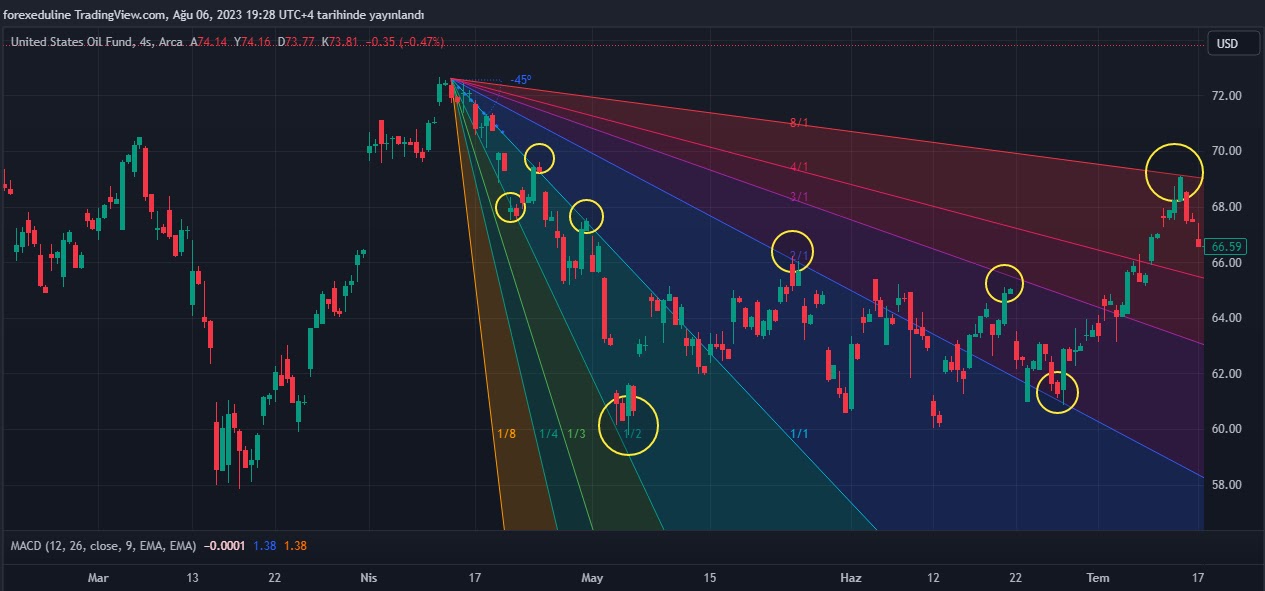 |
| Gann Fan on the United States Oil Fund |
The Gann Fan is often used to determine changes in trends or upper and lower turning points, and it's an effective tool for measuring market trends or strength. If the price stays above a rising angle in a market showing an upward trend, it usually indicates an upward market. If the price stays below a falling angle in a market showing a downward trend, it might suggest a continued downward movement in the market. Also, an angle above or below the price is used to show relative strength or weakness in the market. For example, having the price above the 2x1 angle might indicate a stronger bullish trend compared to the 1x1 angle. Gann believed that when a rising price turns and goes below a falling angle, the price would often move towards the nearest lower angle.
Similarly, in a falling price turning and aiming towards a rising angle, Gann foresaw the price moving towards the next nearest upper angle. When using Gann drawings, it's important to determine the correct price ratio so that one price unit corresponds to one time unit. To set a scale in an unknown market, taking the difference between key points and dividing this difference into market movements from top to bottom or bottom to top is generally the most practical method.
Gann Box
Gann attempted to calculate the Earth's full rotation around the sun by associating it with angles, in an effort to determine it from the perspectives of time and price. Drawing the axes of time and price in equal or proportional dimensions and creating these drawings with Gann angles reveals the formation of the Gann Box. The Gann Box can be used as a powerful tool for identifying and examining recurring price cycles. Users can adjust the time and price range of an anticipated cycle according to their personal needs. The Gann Box serves as a kind of guide that can be used to set targets in the market in this context. It is important to keep in mind the significance of accurately scaling the chart to ensure that the market maintains a square relationship. The box divides and draws price and time into equal divisions, starting from the main pivot point (lowest or highest). Precise price and time levels are customizable elements that users can adjust according to their own strategies. The Gann Box can be employed in various markets and used to forecast fundamental price and time levels. This method can yield effective results whether applied with angles or without angles. Here are the definitive numbers associated with Gann boxes:
- On a monthly basis: 24, 36, 45, 60, 84, 90, 120, 144, 240, and 360
- On a weekly basis: 26, 39, 45, 52, 78, 90, 104, 120, 144, 260
- For a 6-hour session duration in the stock market (5 trading days a week): 6x5, 30, 60, 90, 120, 150, 180, 210, 240, 270
- On an hourly basis (for 24-hour trading): 24x5 (5 trading days a week), 24, 45, 72, 90, 120, 240, 360, 480, 720
- On a 30-minute basis (for 24-hour trading): 48x5 (5 trading days a week), 45, 72, 90, 240, 360, 480, 720, 960
- Useful intervals for a Gann box based on 5-minute periods are as follows: 12, 24, 36, 48, 60, 72, 84, 96, 108, 120, 144, 156, 180, 216, 240, 252, 288, 300
Recurring ratios in the price and time intervals of a product are calculated by multiplying and dividing with ratios determined based on targeted short-term or long-term forecasts. The Gann box is formed through a combination of price and time ratios. Horizontal and vertical lines calculated based on a specific period or price difference of a particular product define the support and resistance levels of prices. Gann boxes are created using at least two Gann angles, and analysis can also be conducted with up to four Gann angles. For instance, when a price movement in a downtrend reaches the line of the Gann box, a reversal movement is anticipated. It is expected that this upward trend will continue until it reaches the area defined by the Gann box. Let's look at an example on the chart of the United States 10 Year Government Bonds Yield bond graph:
 |
| Gann Box on US10Y |
As seen in the chart above, the Gann box establishes a precise visual guide for identifying these critical market boundaries. The interaction between the bond yield's price action and the predetermined geometric angles illustrates how the market respects these calculated levels. When the yield hits the lower boundaries of the box, we observe the anticipated stabilization or reversal, proving that even complex government bond movements often align with Gann's mathematical structure. This specific example highlights the practical power of using multiple angles to forecast where the next major move might occur.
Gann Square
One of W.D. Gann's prominent technical analysis methods is known as the Gann Square. This approach involves an analysis technique created using the symmetry of price and time. The Gann Square is a sophisticated analysis method used to obtain meaningful results on charts. Specifically, the foundation of this approach is built on positioning charts in a square shape, emphasizing that prices are in a squared relationship. One feature of this technique is its ability to define critical support and resistance levels by marking the current price movement on a chart that encompasses the entire time range. The 45-degree fan line indicates a particular trend direction and plays a vital role in the application of the Gann Square. The specific positioning of prices within the Gann Square aims to generate important signals for predicting future price movements.
 |
| Gann Square on Turkish Airlines Inc. Stock |
Establishing a 9-based series is crucial in the Gann Square approach. This series allows for seamless number transitions and works in harmony with the Gann angle system. The 9-based system is based on the premise that circles, triangles, and squares intersect at a total of 9 points. High price movements are placed onto a grid created with specially designed Gann angles. This formation appears like the x and y axes of a square, and this framework, where abrupt price changes occur, is used for identifying support and resistance levels. The 9-based square series, created based on price and time, moves in a spiral manner clockwise from the center and increases in numbers. According to some experts, Gann's nine-cell squares represent specific vibration points. This square, sized relative to the starting point, covers the process from the beginning of price analysis to the present day. The diagonal lines and intersection points within the Gann Square provide important information for understanding the market's strength or weakness.
Half Retracement Rule
Another impactful strategy presented by Gann in the financial markets is known as the "Half Retracement Rule." According to him, utilizing half retracement levels is a true mastery. The fundamental focus of this rule is knowing when to use it most effectively. The primary goal is to recognize formations and convert these formations into profits. To achieve this goal, charts should guide and trading should be conducted in the direction of the trend. If a distinct trend change is not observed, positions should not be altered. If prices close outside the retracement zones, the first support and resistance levels are tested, and this often signals a trend reversal. Prices often retrace about 45-50% of the previous movement in this context, it has been observed. However, if prices approach this level without reaching a 50% retracement, the position should be closed. Along with this information, Gann has indicated the following points to be taken into consideration:
- Determining the bottom level depends on the next move in bull markets.
- Before a correction, the most clearly defined peak level should be identified.
- The identified lowest level should be subtracted from the highest level to initiate the correction movement.
- Multiplying this difference by 50% helps determine the duration of the correction.
- Subtracting this found difference from the highest peak level indicates where the correction will end.
This way, how much a 50% retracement level will support a correction is determined right after the bottom and peak formations. During the application of the 50% retracement rule, attention should also be paid to the possibilities of a 63%, 75%, and 100% retracement. The stop-loss level should be placed in the 66% retracement zone. This approach is an effective way to detect the emergence of a new trend instead of a lower-degree correction movement earlier.
Essential Questions Regarding Gann Theory
Find direct answers to the most frequent inquiries about Gann's unique approach to the markets and how his principles apply to modern trading tools.